
Water leakage in concrete structures is rarely limited to the visible surface. Water can travel through cracks, construction joints, internal voids, and porous areas before appearing in basements, tunnels, walls, or other underground structures.
Polyurethane injection grouting is commonly used to fill these hidden leakage paths. However, the effectiveness of the repair depends not only on the injection method, but also on selecting the right polyurethane grout for the actual site conditions.
Two common options are hydrophilic polyurethane and hydrophobic polyurethane. Both react with water and expand, but their foam properties, sealing behavior, and suitable leakage conditions are different.
Key takeaways
- Hydrophilic polyurethane reacts with water and forms a flexible foam suitable for damp cracks, construction joints, and areas exposed to repeated moisture.
- Hydrophobic polyurethane reacts rapidly with water and forms a high-expansion, water-resistant foam commonly used for active leaks, rapid water stopping, and void filling.
- Material selection should consider water flow, crack size, substrate condition, reaction speed, foam expansion, and the required flexibility.
- A complete PU injection system typically includes polyurethane grout, a high-pressure grouting machine, injection packers, hoses, couplers, cleaning materials, and installation tools.
What is hydrophilic polyurethane?
Hydrophilic polyurethane is a water-reactive injection material that absorbs moisture and reacts with water. After being injected into a crack, joint, or internal void, it expands and forms a flexible foam that helps fill irregular leakage paths.
Because the cured material remains responsive to moisture and provides good flexibility, hydrophilic polyurethane is commonly considered for damp cracks, construction joints, and areas that may experience repeated water exposure or slight structural movement.
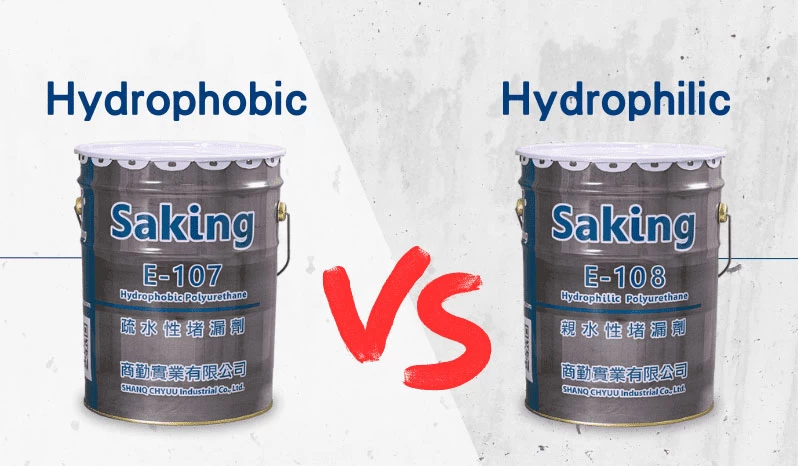
Saking’s E-108 Hydrophilic Polyurethane is a single-component material designed to react with water and expand into a high-elastic foam. It provides good toughness, elongation, chemical resistance, and adhesion for water-stopping applications.
How does hydrophilic polyurethane work?
During PU injection, hydrophilic polyurethane is pumped through injection packers into cracks, construction joints, or internal voids.
Once the material contacts water, it begins to react and expand. The foam follows irregular spaces within the concrete and helps block the path through which water is entering.
The reaction speed may vary depending on several factors:
- Material formulation
- Ambient temperature
- Water temperature
- Moisture conditions
- Injection pressure
- Crack or void size
Higher temperatures may accelerate the reaction between E-108 and water. Contractors should therefore evaluate the site environment before selecting the injection method and operating settings.
What is hydrophobic polyurethane?
Hydrophobic polyurethane is a water-reactive grout that forms a water-resistant foam after contact with moisture.
It is commonly selected when rapid expansion, quick water stopping, or the filling of larger cracks and internal voids is required. After foaming, the material fills the available space and creates a barrier that helps reduce further water penetration.
Saking’s E-107 Hydrophobic Polyurethane is a single-component, high-expansion material with good adhesion. It reacts quickly after contact with water and is designed for rapid leakage control.
How does hydrophobic polyurethane work?
Hydrophobic polyurethane is injected into cracks, cavities, or leakage paths using a high-pressure grouting machine.
When the grout contacts water, a chemical reaction causes the material to foam and expand. The expanding foam fills the surrounding space, blocks the water path, and forms a water-resistant barrier.
Depending on the construction conditions, the foaming speed of E-107 may also be adjusted with a suitable amount of catalyst.
Hydrophilic vs. hydrophobic polyurethane
Hydrophilic and hydrophobic polyurethane can both be used in basements, tunnels, underground structures, and concrete crack repairs. The main difference is not simply where they are used, but the type of leakage condition and repair objective they are selected for.
| Comparison | Hydrophilic polyurethane | Hydrophobic polyurethane |
|---|---|---|
| Main repair objective | Flexible sealing in damp conditions | Rapid water stopping and void filling |
| Suitable water condition | Dampness, seepage, repeated moisture exposure, or areas with large amounts of water or heavy seepage where rapid water stopping is required | Active leakage or visible water flow, especially where the structure contains small or irregular water paths |
| Suitable crack condition | Fine cracks, construction joints, and areas with slight movement | Larger cracks, gaps, cavities, and internal voids |
| Foam behavior | Flexible and reactive when exposed to water | High-expansion and water-resistant |
| Typical use | Long-term sealing of damp cracks and construction joints | Emergency leak control, initial water stopping, and filling of voids |
| Saking material | E-108 Hydrophilic Polyurethane | E-107 Hydrophobic Polyurethane |
This comparison is intended as a general guide. Actual repair performance may vary depending on the material formulation, crack condition, water pressure, temperature, and injection method.
The same project may require both materials. For example, hydrophobic polyurethane may first be used to control active water flow. Hydrophilic polyurethane can then be used to treat remaining damp cracks or construction joints that require additional sealing.
How to Choose Between Hydrophilic and Hydrophobic Polyurethane
No single polyurethane grout is suitable for every leakage condition. Before selecting a material, contractors should evaluate the water source, crack characteristics, structural condition, and intended repair result.
| Selection factor | Choose hydrophilic polyurethane when | Choose hydrophobic polyurethane when |
|---|---|---|
| Water condition | The crack or construction joint remains damp or is repeatedly exposed to moisture | The leakage involves active or visible water flow |
| Repair objective | Flexible and long-lasting sealing is required, along with rapid water stopping | Cracks and leakage paths in the structure need to be filled |
| Crack condition | Larger cracks, holes, or internal voids need to be filled | The leakage paths are narrow or irregular, or the area is difficult to inject |
| Structural movement | The joint may experience slight movement | Structural movement is limited and rapid filling is more important |
| Material performance | Good elongation, toughness, and flexibility are required | High expansion and fast reaction are required |
| Repair stage | Used for sealing remaining damp cracks or joints | Used for immediate water control during the initial repair stage |
How to match PU grout with the right injection equipment
Choosing the right polyurethane grout is only one part of an effective leak repair. Injection pressure, packer size, crack condition, and equipment compatibility all affect whether the material can reach the full leakage path and form a consistent seal.
A typical PU injection system includes:
- High-pressure grouting machine
- Injection hose and coupler
- Injection packers
- Hydrophilic or hydrophobic polyurethane grout
- Drill and installation tools
- Polyurethane cleaner
- Personal protective equipment
The grouting machine should deliver stable pressure so the material can penetrate narrow cracks and internal voids without interruption. Packer size and injection settings should also be selected according to the crack width, substrate condition, water flow, and site environment.
When the grout, machine, packers, and injection settings are properly matched, contractors can achieve better material penetration, more complete crack filling, and more consistent leak-repair performance.
Effective leak repair depends on more than choosing between hydrophilic and hydrophobic polyurethane. Crack size, water flow, water pressure, substrate condition, reaction speed, injection equipment, and packer selection should all be evaluated together.
With more than 30 years of experience in high-pressure grouting and leak-repair equipment, Saking provides grouting machines, injection packers, polyurethane materials, cleaners, and related accessories for different PU injection applications.
To learn more about E-107 Hydrophobic Polyurethane, E-108 Hydrophilic Polyurethane, or suitable injection equipment, contact Saking with details about your leakage conditions, site environment, and equipment requirements.
Frequently asked questions
1. What is hydrophilic polyurethane?
Hydrophilic polyurethane is a water-reactive injection material that absorbs moisture and reacts with water. It expands into a flexible foam that helps fill cracks, construction joints, and internal leakage paths.
2. What is hydrophilic polyurethane used for?
Hydrophilic polyurethane is commonly used for damp concrete cracks, construction joints, and areas exposed to repeated moisture where more flexible sealing performance is required.
3. What is the difference between hydrophilic and hydrophobic polyurethane?
Hydrophilic polyurethane absorbs moisture and typically forms a more flexible foam. Hydrophobic polyurethane forms a high-expansion, water-resistant foam and is generally used for rapid water stopping and void filling.
4. Is hydrophilic polyurethane suitable for active water leaks?
Hydrophilic polyurethane can be used in damp and leaking areas, but the correct material should be selected based on water flow, crack size, water pressure, and the required reaction speed. For strong active leakage, a faster-reacting material may be used first, followed by hydrophilic polyurethane in a staged injection process.
5. Can hydrophilic polyurethane be injected into wet concrete cracks?
Yes. Hydrophilic polyurethane is designed to react with water, making it suitable for damp or wet cracks. However, the crack condition, substrate, and injection pressure should still be evaluated before construction.
6. Which polyurethane grout is better for basement leakage?
The choice depends on the actual leakage condition. Hydrophilic polyurethane may be considered for damp fine cracks, construction joints, and areas where flexible sealing is required. For active water flow, visible leakage, or larger internal voids, hydrophobic polyurethane is generally more suitable for rapid expansion and water stopping.
7. What equipment is required for polyurethane injection?
Common equipment includes a high-pressure grouting machine, injection hose, coupler, injection packers, polyurethane grout, drilling tools, installation tools, and a suitable polyurethane cleaner.
8. Why should a grouting machine be cleaned immediately after use?
Uncured polyurethane may remain inside the pump, hose, coupler, and injection accessories. Once the material hardens, it may cause blockage and affect equipment performance. Cleaning the system immediately after construction helps reduce material buildup and the risk of clogged components.
9. Can hydrophilic and hydrophobic polyurethane be used in the same project?
Yes. Different leakage locations within the same structure may require different materials. For example, hydrophobic polyurethane may first be used to control active water flow, while hydrophilic polyurethane can then be used to seal remaining damp cracks or construction joints.
Update: 2024-12-29
Saking specialize in the manufacture of high pressure grouting machines, hardware tools, and leak-proofing materials.