
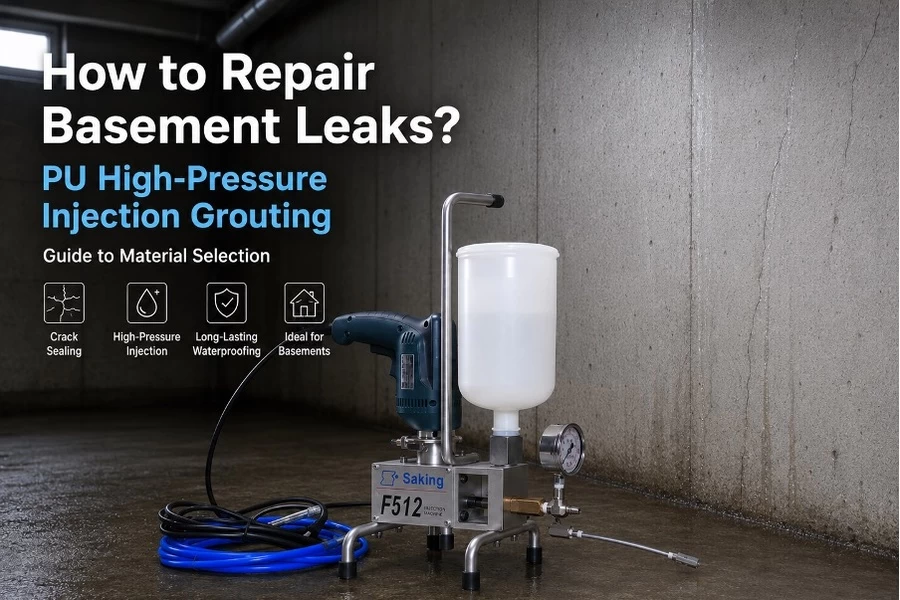
Basement water leakage is one of the most common waterproofing problems in concrete buildings. Because basements are located below or close to ground level, they are often exposed to groundwater pressure, moisture, construction joints, and concrete cracks. Once water finds a leakage path, it may continue to seep through walls, joints, or structural cracks.
For waterproofing contractors and repair professionals, PU injection grouting is a practical method for stopping water leakage from inside the concrete structure. By using a grouting machine, injection packers, and suitable polyurethane grouting material, the grout can be injected into cracks or voids to seal the leakage path.
This article explains how basement water leakage repair works, when PU injection grouting is suitable, and how to select the right equipment and materials for concrete crack sealing.
Key takeaways
For basement water leakage repair, the key is not only to seal the surface, but to stop water movement inside the concrete crack or leakage path. PU injection grouting is commonly used for this purpose because polyurethane material can be injected into cracks, joints, and voids to form a water-resistant seal.
- Basement leaks are commonly related to concrete cracks, construction joints, groundwater pressure, or hidden voids.
- PU injection grouting is suitable for repairing wet cracks, active leakage, and internal leakage paths.
- Grouting machines, injection packers, and polyurethane grouting materials should be selected as a complete repair system.
- Material selection depends on the crack condition, water flow, water pressure, and required expansion performance.
Why basement water leakage happens
Basement leakage usually occurs when water enters through weak points in the concrete structure. These weak points may not always be visible from the surface, which is why surface coating alone may not solve the problem.
Common causes of basement water leakage include:
- Concrete wall cracks caused by shrinkage, settlement, or structural movement
- Construction joints between concrete pours
- Honeycombs, voids, or porous concrete areas
- Pipe penetrations or wall openings
- Groundwater pressure from outside the basement wall
- Aging waterproofing layers or failed external waterproofing systems
When water pressure continues to push moisture into the structure, the leakage path must be sealed from within the crack or void. This is where PU injection grouting can provide an effective repair method.
What is PU injection grouting?
PU injection grouting is a waterproofing repair method that injects polyurethane material into concrete cracks, joints, or cavities. The material reacts and expands after injection, filling the internal leakage path and forming a water-resistant seal.
In basement leak repair, PU injection grouting is often used for:
- Basement wall crack repair
- Basement crack injection repair
- Concrete wall crack repair
- Construction joint leakage repair
- Active water leakage repair
- Underground structure waterproofing
Compared with surface patching, injection grouting targets the leakage path inside the structure. This makes it especially useful when water is entering through deep cracks, hidden voids, or narrow paths that cannot be sealed from the surface alone.
For more information about grouting machine selection, you can refer to Saking’s article: Grouting Machine Buying Guide: PU vs. Cement, Pressure and Applications.
How PU injection grouting repairs basement water leakage
The basic principle of basement water leakage repair is to inject polyurethane grout into the crack or void until the material reaches the leakage path and seals it.
A typical PU injection repair process includes the following steps:
- Inspect the leakage area
Identify the water source, crack direction, leakage volume, and concrete condition. - Drill injection holes
Holes are drilled along the crack or leakage path at suitable spacing and angle. - Install injection packers
Injection packers are inserted into the drilled holes to create secure injection points. - Inject polyurethane grout
A high pressure grouting machine injects PU material through the packers into the crack. - Allow the material to expand and seal
The polyurethane reacts, expands, and fills the crack or void to block water movement. - Remove packers and finish the surface
After the material cures, packers are removed and the surface can be patched.
The quality of the repair depends on correct pressure control, material selection, crack diagnosis, and proper use of injection accessories.
Equipment needed for basement leak repair
A basement water leakage repair project usually requires more than one product. The equipment and materials must work together as a complete injection system.
1. Grouting machine
A PU grouting machine or high pressure grouting machine is used to inject polyurethane material into cracks and joints. For basement leakage repair, the machine should provide stable pressure, reliable output, and compatibility with PU materials.
Related reading: The Key Role of High Pressure Grouting Machines in Grouting Projects
2. Injection packer
An injection packer, also called a PU injection packer or high-pressure injection needle, creates a fixed injection point for the grout. It helps deliver the material into the crack under pressure and reduces material leakage during injection.
Related reading: How Saking’s Injection Packer Enhances Construction Quality
3. Polyurethane grouting material
The choice of polyurethane grouting material affects the sealing result. For basement water leakage, contractors often evaluate whether hydrophilic or hydrophobic polyurethane is more suitable based on moisture condition, crack size, water flow, and repair purpose.
Related reading: E-108 Hydrophilic Polyurethane: The Professional Choice for Crack Repair and Waterproofing
Hydrophobic or hydrophilic polyurethane: Which is better for basement leaks?
Both hydrophilic and hydrophobic polyurethane can be used for basement waterproofing and leak repair, but they are suitable for different leakage conditions. The right material should be selected based on the leak location, crack condition, water volume, and whether water is continuously entering the structure, rather than simply by the application environment.
| Material Type | Key Feature | Suitable Applications |
|---|---|---|
| Hydrophilic Polyurethane | Reacts and expands upon contact with water, providing water absorption and void-filling properties | Suitable for large water flow, continuous water ingress, or areas requiring rapid water stopping. It can be used first to stop obvious or active leakage. |
| Hydrophobic Polyurethane | Repels water and forms a relatively dense foam structure after curing | Suitable for damp cracks, seepage through concrete structures, ceiling dripping, and humid conditions where visible moisture or leakage is present, but without heavy water flow or flooding. |
For basement leak repair, the material should not be selected based on its name alone. The actual site condition is more important. If the crack remains damp or repeatedly experiences seepage, hydrophobic polyurethane may be more suitable. If the water flow is more obvious and rapid water stopping or filling of larger voids is required, hydrophilic polyurethane may be considered.
A practical selection should consider:
- Water flow rate
- Crack width and depth
- Water pressure
- Concrete condition
- Required expansion
- Required flexibility after curing
- Injection pressure and equipment compatibility
For a deeper comparison, see: Understanding Hydrophobic and Hydrophilic Polyurethane Applications and Benefits
When is PU injection grouting suitable for basement water leakage repair?
PU injection grouting is suitable when the leakage path is located inside concrete cracks, joints, or voids. It is commonly used when water cannot be stopped effectively by surface treatment alone.
Suitable conditions include:
- Water leaking through basement wall cracks
- Damp or wet concrete cracks
- Leakage from construction joints
- Repeated seepage after surface repair
- Localized active water leakage
- Hidden leakage paths inside concrete structures
However, PU injection grouting may not be the only solution for every basement problem. If the leakage is caused by drainage failure, large-scale external waterproofing damage, or serious structural movement, additional repair methods may be needed.
Concrete crack sealing vs. PU injection repair
Basement wall crack repair can involve different methods. Surface sealing may be suitable for minor dry cracks, but it may not solve leakage caused by water pressure behind the wall.
| Repair Method | Main Purpose | Suitable Condition |
|---|---|---|
| Surface crack sealing | Covers visible surface cracks | Dry or minor cracks without active leakage |
| PU injection grouting | Seals cracks from inside the structure | Wet cracks, active leakage, internal leakage paths |
| Epoxy injection | Structural bonding and crack reinforcement | Dry structural cracks requiring strength restoration |
| External waterproofing | Blocks water from the outside | Large-scale waterproofing system repair |
For basement leakage, PU injection grouting is often preferred when the priority is water stopping and internal crack sealing.
Common mistakes in basement PU injection repair
To improve repair quality, contractors should avoid the following common mistakes:
- Using the wrong polyurethane material for the leakage condition
- Injecting at uncontrolled pressure
- Installing injection packers too far from the crack path
- Not checking whether the leakage is caused by structural movement
- Stopping injection before the material fully fills the leakage path
- Ignoring cleaning and maintenance of the grouting machine after use
Proper equipment, material selection, and injection technique are essential for long-term repair performance.
FAQ
Q1 What are the common causes of basement water leakage?
Common causes of basement water leakage include concrete cracks, construction joints, holes, honeycombed concrete, groundwater pressure, leakage around pipe penetrations, and aging or failed waterproofing layers. Water usually enters the interior through cracks, joints, or pores that provide the easiest path for seepage.
Q2 What types of basement leaks can be repaired with high-pressure injection?
High-pressure injection is commonly used to repair leaking concrete cracks, basement wall seepage, construction joint leakage, and localized active leaks. If the water is entering through internal concrete cracks or joints, high-pressure injection can usually reach the leakage path more effectively than surface waterproofing alone.
Q3 Does the high-pressure injection method vary depending on the injection material?
Yes. Different PU injection materials have different reaction times, expansion ratios, viscosities, and cured properties. Therefore, the injection method should be adjusted according to the material characteristics, crack width, water flow, and on-site water pressure.
Q4 Can PU high-pressure injection stop basement water leakage?
Yes. If basement leakage is caused by cracks, joints, or internal voids in the concrete, PU high-pressure injection can deliver the material directly into the leakage path. The material then expands or cures to form a water-blocking seal.
Q5 What equipment is needed for basement leak repair?
A typical PU high-pressure injection setup includes a high-pressure injection machine, injection packers, high-pressure hoses, grease couplers, shut-off valves, and PU injection materials. The actual equipment configuration should be selected according to the leakage condition and project requirements.
Q6 Should hydrophilic or hydrophobic PU be used for basement leak repair?
The choice depends on the actual site conditions. Hydrophobic PU is commonly used for damp cracks or areas with long-term seepage, while hydrophilic PU is often used where water flow is more noticeable, rapid water stopping is required, or larger voids need to be filled.
Q7 Can PU high-pressure injection permanently repair basement wall cracks?
If the source of the leakage is correctly identified, the proper injection method is used, and high-quality materials are applied, PU high-pressure injection can effectively seal cracks and improve water leakage problems.
However, the long-term repair performance also depends on the condition of the building structure. If an earthquake, structural movement, settlement, or continuous stress occurs later, the original cracks may reopen or new cracks may develop elsewhere. In such cases, water leakage may recur and additional repairs may be required.
In addition, if the leakage is caused by aging exterior waterproofing, poor drainage, or other structural problems, PU injection alone may not completely solve the issue. Other waterproofing or structural repair methods may also be necessary.
Saking basement leakage repair solutions
Basement leakage repair requires the right combination of injection equipment, packers, and polyurethane grouting materials. Saking provides high pressure grouting machines, injection packers, PU grouting materials, and related accessories for contractors handling basement water leakage, concrete crack sealing, and building leakage repair projects.
For product selection, please share your leakage condition, crack width, water flow, site environment, and required repair result with Saking. Our team can help recommend a suitable grouting machine, injection packer size, and polyurethane material combination for your application.
Contact Saking to discuss your basement water leakage repair project and find the right PU injection grouting solution.
Update: 2026-10-02
Saking specialize in the manufacture of high pressure grouting machines, hardware tools, and leak-proofing materials.